Summary
Most warehouse and office break-ins, pilferage cases, and safety incidents in India happen because of small, everyday gaps – a broken gate light, an untrained guard, a camera pointed the wrong way. This article walks through a 15-point checklist to help you spot the warning signs of weak warehouse security, and lays out practical fixes involving CCTV monitoring, trained guarding staff, and structured site security audits.
Table of Contents
| 1. Why Warehouse Security Deserves Your Attention |
| 2. 15 Signs Your Office or Warehouse Is Under-Secured |
| 3. What to Do About It: Fixing the Gaps |
| 4. Choosing the Right Security Guard Company |
| 5. Warehouse Safety vs Warehouse Security: Why Both Matter |
| 6. Conclusion |
Every year, Indian businesses lose crores of rupees to theft, pilferage, and preventable accidents inside facilities that looked secure on paper but weren’t in practice. Weak warehouse security rarely announces itself with a dramatic break-in. It shows up quietly – a side gate that’s never locked, a CCTV camera that hasn’t recorded anything in three weeks, a guard who’s never been trained to check a delivery challan properly. By the time the gap becomes obvious, the damage is already done.
If you manage a warehouse, distribution centre, or office campus in India, this checklist will help you identify where you’re exposed – and what to do next.
Why Warehouse Security Deserves Your Attention
India’s warehousing sector has grown rapidly with the boom in e-commerce, 3PL logistics, and manufacturing hubs around cities like Delhi NCR, Mumbai, Bengaluru, and Patna. But this growth has outpaced security planning in many facilities. Sprawling layouts, multiple entry points, night-shift operations, and high-value inventory make warehouses and large offices attractive, low-risk targets for both external theft and internal pilferage.
A single security lapse can mean stolen inventory, damaged goods, injured staff, insurance disputes, or a client walking away after an audit finds your facility doesn’t meet their compliance standards. Getting site security right isn’t just about locks and guards – it’s about protecting your bottom line and your reputation.
Before you invest in new equipment or staff, it helps to know exactly what to look for. That’s where this checklist comes in.
15 Signs Your Office or Warehouse Is Under-Secured
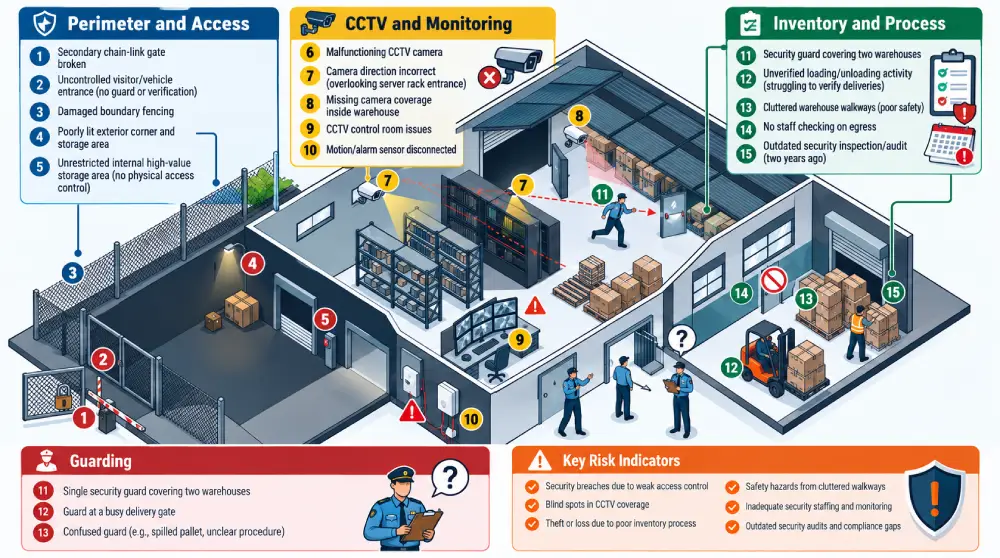
Perimeter and Access Control Red Flags
- Unmonitored or unlocked secondary entrances
Loading bays, fire exits, and vendor gates are often left open for convenience and forgotten about. - No visitor or vehicle log
If anyone can walk in without signing a register or showing ID, you have no record trail if something goes missing. - Damaged or missing boundary fencing
Gaps in compound walls or fencing are the easiest entry points for intruders. - Poor perimeter lighting
Dark corners near gates, parking areas, and loading docks are where most after-hours incidents happen. - No access control system at internal doors
Warehouses storing high-value goods, electronics, or pharma stock need restricted zones – not open-floor access for every employee.
CCTV and Monitoring Gaps
- Cameras that don’t actually work
Non-functional or poorly maintained CCTV cameras give a false sense of security. Regular audits often reveal that a third or more of installed cameras aren’t recording properly. - Blind spots in coverage
Storage racks, dock doors, and staff entry points are common blind spots that go unnoticed until an incident occurs. - No live CCTV monitoring
Recorded footage helps after the fact, but without live CCTV monitoring, nobody catches a problem while it’s happening. - No integration between CCTV and alarm systems
Modern CCTV solutions should trigger alerts automatically – a motion sensor going off at 2 AM with nobody watching the feed defeats the purpose.
Guarding and Staffing Weaknesses
- Understaffed shifts, especially at night
A single guard covering a large facility across multiple gates cannot realistically monitor everything. - Untrained or unverified guards
Security personnel without background verification, proper training, or SOPs for handling emergencies are a liability, not a safeguard. - No standard operating procedures (SOPs)
If your guards don’t have written protocols for checking vehicles, verifying deliveries, or handling suspicious activity, response quality depends entirely on individual judgment.
Process and Inventory Control Issues
- No system for tracking stock movement in and out
Without checks at the point of loading and unloading, pilferage is easy to hide. - Poor housekeeping and signage
Cluttered walkways, missing hazard signs, and unmarked restricted zones increase both safety risk and theft opportunity – this is where warehouse safety and warehouse security overlap directly. - No recent security audit
If it’s been over a year since anyone formally assessed your facility’s vulnerabilities, you’re likely operating with blind spots you don’t even know about.
If three or more of these apply to your facility, it’s a strong signal that your current setup needs a serious review – not a patch job.
What to Do About It: Fixing the Gaps
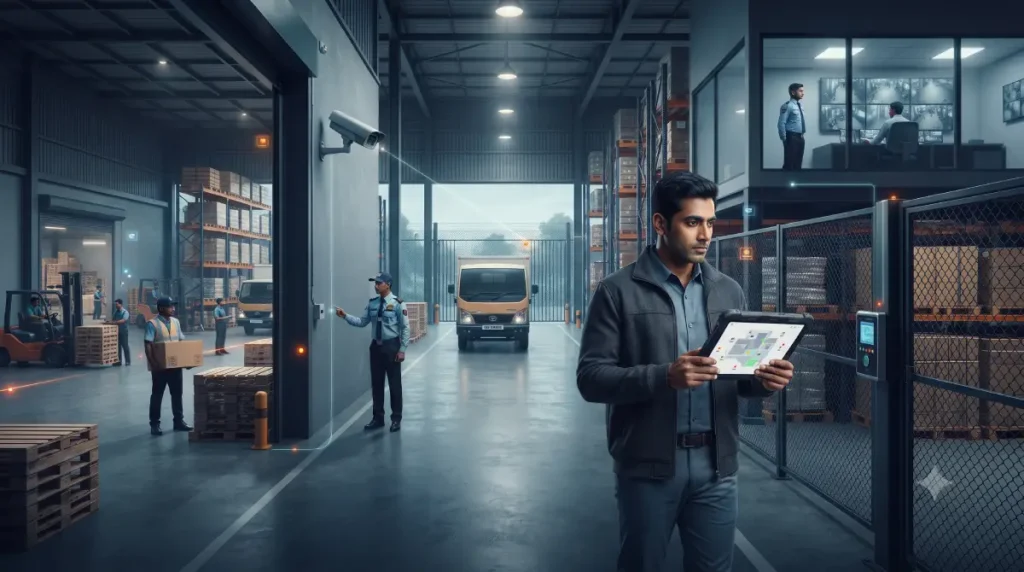
Identifying the problem is only half the job. Here’s how Indian businesses typically close these gaps in a structured, cost-effective way.
Get a Professional Site Security Assessment
Before spending on new equipment, get a proper site security audit done. A qualified security partner will walk your facility, map every entry and exit point, review your current CCTV coverage, and assess guard deployment against your actual risk profile – not a generic template. This is usually the fastest way to prioritise where your budget should go first. Many facilities find that working with an established security guard company for this initial assessment saves significant rework later, since the same team can then design and implement the fix.
Upgrade Your CCTV Monitoring and Coverage
- Map blind spots and add cameras at all dock doors, racking aisles, gate entries, and parking areas.
- Move from passive recording to active CCTV monitoring, either through an in-house control room or an outsourced remote monitoring service that flags unusual activity in real time.
- Invest in modern CCTV solutions with motion analytics, license plate recognition for vehicle gates, and cloud backup so footage isn’t lost if a local device is tampered with.
- Set a maintenance schedule – cameras should be checked monthly, not only when something goes wrong.
Strengthen Access Control
- Install boom barriers or turnstiles at vehicle and pedestrian entry points.
- Use ID-based or biometric access for internal restricted zones like high-value storage or server rooms.
- Maintain a digital visitor and vendor log instead of a paper register that’s easy to falsify or lose.
Deploy Trained, Verified Security Guards
Equipment alone doesn’t secure a facility – trained people do. Reliable security guard services should include:
- Police-verified and background-checked personnel
- Clear SOPs for gate checks, patrol rounds, and emergency response
- Adequate headcount for your shift patterns, especially during night operations
- Regular supervision and audit of guard performance, not just deployment
Partnering with an experienced security guard company that understands warehouse and industrial environments – rather than a generic staffing vendor – makes a measurable difference in how consistently protocols are actually followed on the ground.
Fix Warehouse Safety Basics Alongside Security
Security and safety improvements often go hand in hand. Clear walkway markings, proper hazard signage, fire exit visibility, and organised storage reduce both accident risk and opportunities for theft. A facility that looks disciplined tends to be treated with more caution by anyone considering taking advantage of it.
Build a Recurring Review Cycle
Security isn’t a one-time fix. Schedule a formal review every six to twelve months, and after any major change – new layout, new shift pattern, new high-value inventory line, or after any incident, however small.
Choosing the Right Security Guard Company
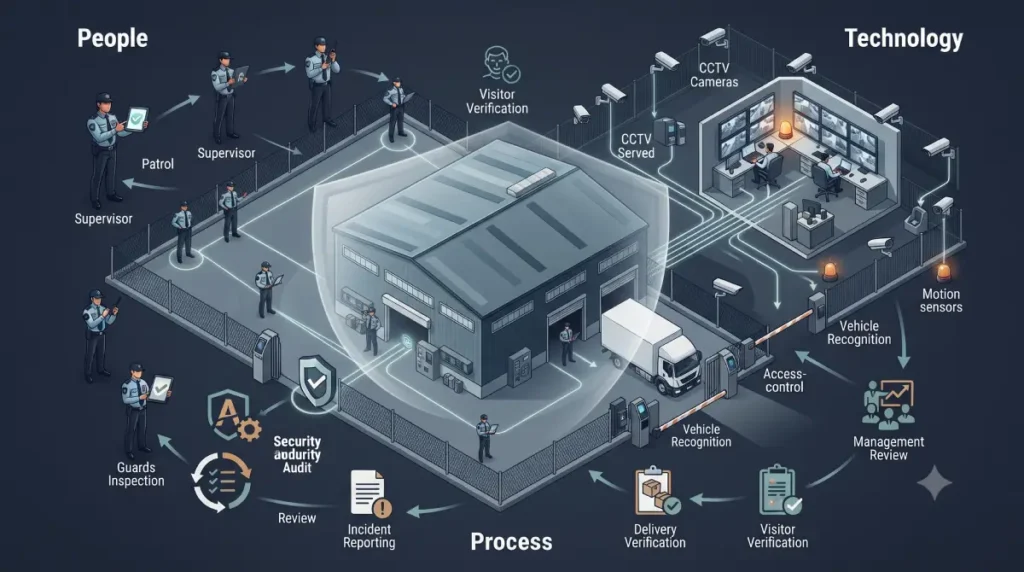
Not all providers of security guard services are equal, and for a warehouse or large office campus, the difference shows up quickly in day-to-day operations. When evaluating a security guard company in India, look for:
- Experience specifically with warehousing, logistics, or industrial clients – not just retail or residential security
- In-house training infrastructure for guards, not just outsourced recruitment
- Integrated offerings that combine manned guarding with CCTV solutions and remote monitoring, so you’re not managing multiple vendors
- Transparent reporting – daily logs, incident reports, and periodic audits shared with you, not just a guard standing at the gate
- Scalability, so coverage can flex up during peak season (festive dispatch periods, year-end stock audits) without a scramble
A good partner will also help you think beyond guarding alone – combining physical presence with technology and process discipline for stronger overall site security.
Warehouse Safety vs Warehouse Security: Why Both Matter
It’s worth separating two terms that often get used interchangeably. Warehouse safety is about preventing accidents – fire hazards, unsafe racking, forklift incidents, and worker injuries. Warehouse security is about preventing theft, unauthorised access, and deliberate harm. In practice, the two reinforce each other: a well-lit, well-organised, access-controlled facility is both safer for workers and harder to exploit for theft. When you audit one, it’s worth auditing the other at the same time.
Conclusion
Weak warehouse security doesn’t usually announce itself with a break-in – it shows up as small, ignored details that add up over time. Run through the 15-point checklist above honestly, and you’ll likely find at least a few gaps worth addressing right away. The fix isn’t necessarily a large investment; it’s usually a combination of better CCTV monitoring, properly trained guarding staff, tighter access control, and a habit of regular review.
If you’re unsure where to start, the most practical first step is a professional site security assessment from a team that works with warehouses and industrial facilities regularly. It turns a vague sense of “we should probably fix this” into a clear, prioritised action plan – and gives you a partner accountable for keeping your facility secure going forward.