
Choosing between Security Guards and Remote Monitoring comes down to one question: Do you need a physical presence, or continuous digital surveillance backed by a rapid response team?
The Short Answer – For most Indian businesses today, a hybrid security model that blends a smaller guard team with CCTV monitoring service technology delivers the best mix of cost, coverage, and response time. Manned guarding still wins where physical intervention and public-facing deterrence matter most, while remote monitoring wins on round-the-clock coverage and cost efficiency. Below, we break down exactly what each option costs in India, where each one shines, and how to decide what fits your site.
Table of Contents
- What Is Manned Guarding?
- What Is Remote Video Monitoring?
- Manned Guarding vs Remote Monitoring: A Quick Comparison
- Cost Comparison: Security Guards vs Remote Monitoring in India
- Cost of Security Guard Services in India
- Cost of CCTV Monitoring Service in India
- Real Cost Example (Illustrative)
- Pros and Cons of Manned Guarding
- Pros and Cons of Remote Video Monitoring
- When to Choose Manned Guarding
- When to Choose Remote Monitoring
- The Hybrid Security Model: Best of Both Worlds
- How to Choose the Right Security Solution for Your Business
- Conclusion
- Frequently Asked Questions
What Is Manned Guarding?
Manned guarding is the traditional security model: a trained guard is physically present on-site, patrolling, checking IDs, controlling access, and responding to incidents in real time. It’s the model most Indian offices, residential societies, warehouses, and retail stores have relied on for decades, typically delivered through security guard services contracted from a licensed security guard company.
What Is Remote Video Monitoring?
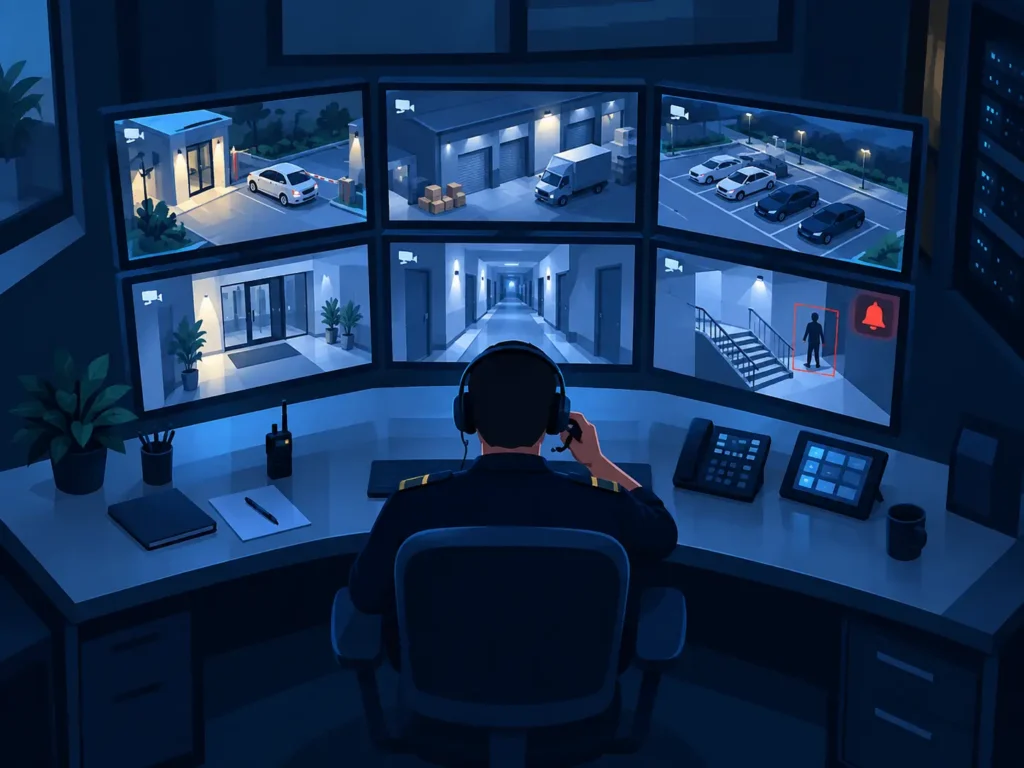
Remote video monitoring (also called remote guarding or a Security Monitoring service) uses strategically placed CCTV cameras, sensors, and sometimes AI-based analytics, all watched by a remote operations centre. When the system detects unusual activity – an intrusion, loitering, or a breach after hours – a trained operator verifies the event on screen and responds instantly: triggering audio warnings, alerting on-site staff, or dispatching a local response unit and the police. This is the core of most modern CCTV monitoring service offerings in India today.
Manned Guarding vs Remote Monitoring: A Quick Comparison
| Factor | Manned Guarding | Remote Monitoring |
|---|---|---|
| Coverage | Limited to guard’s physical location and shift | Continuous, covers every camera zone simultaneously |
| Cost | High – ongoing salary, PF, ESI, uniforms, supervision | Lower – fixed monthly fee, scales with camera count |
Response Speed | Immediate but only where the guard is standing | Instant detection, verified response within seconds |
| Human Judgment | Strong – can physically intervene | Present but remote; escalates to local response teams |
| Scalability | Needs more guards for more area or shifts | Add cameras/sites without proportional cost increase |
| Reliability | Affected by fatigue, breaks, absenteeism, turnover | Consistent 24/7, no fatigue or attrition |
| Evidence & Reporting | Guard logs, often manual and inconsistent | Recorded footage, timestamped, audit-ready |
| Deterrent Value | Visible human presence | Visible cameras + audio warnings |
Cost Comparison: Security Guards vs Remote Monitoring in India
Cost is usually the deciding factor for Indian businesses, so let’s look at real numbers.
Cost of Security Guard Services in India
Unarmed security guard salaries in India typically fall between roughly ₹15,000 and ₹17,000 per month depending on the city and year, with rates in metros like Gurugram and Delhi following a similar band. However, this is only the guard’s take-home pay. What a business actually pays an agency for security guard services is considerably higher once you factor in:
- Provident Fund (PF) and ESI contributions
- Uniforms, training, and equipment
- Supervisor visits and agency overheads
- Agency service margin (typically 15–25%)
For a single unarmed guard on an 8-hour shift, businesses in India commonly pay agencies ₹18,000–₹28,000 per month per shift. For round-the-clock coverage (3 shifts a day, 7 days a week), that multiplies to ₹55,000–₹85,000+ per month for a single point, and significantly more if the site needs multiple guards covering different entry points.
Cost of CCTV Monitoring Service in India
A CCTV monitoring service is usually priced as a flat monthly fee based on the number of cameras, site complexity, and response requirements – not the number of hours staffed. Depending on the provider, camera count, and whether AI analytics and on-call response are included, Indian businesses typically pay anywhere from ₹8,000 to ₹35,000 per month for full-site remote monitoring, regardless of whether coverage runs 8 hours or 24 hours. This is because one remote operator can simultaneously monitor dozens of sites, spreading the cost across many clients – a structural advantage manned guarding simply cannot replicate.
Real Cost Example (Illustrative)
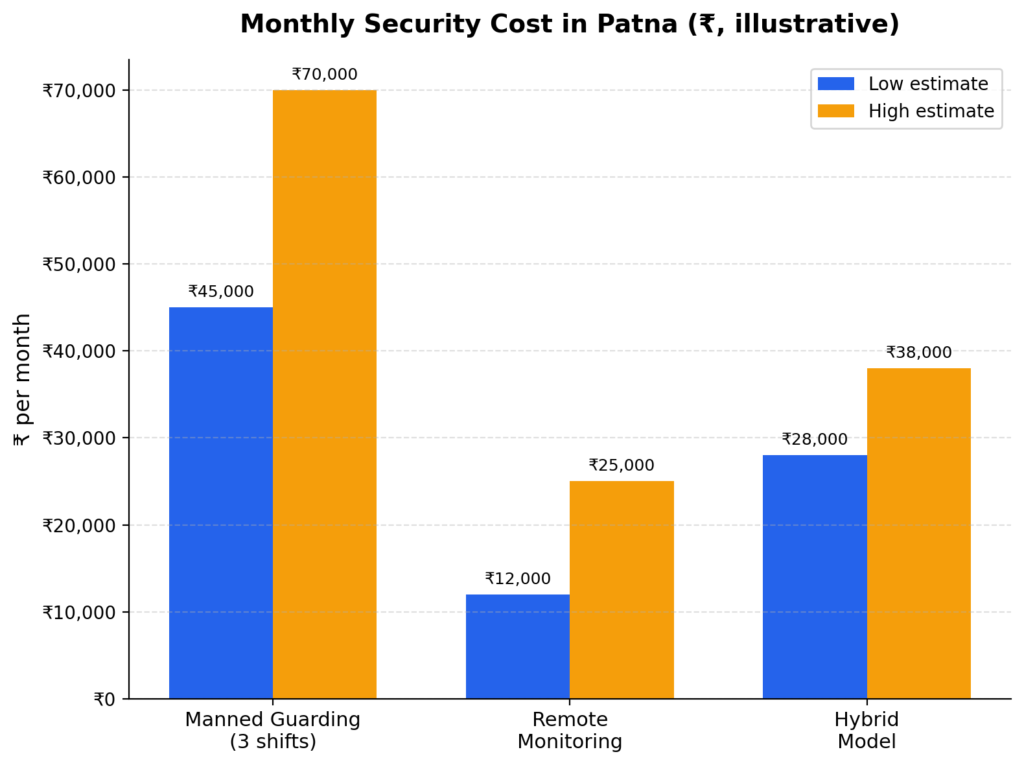
Consider a mid-sized warehouse in Patna needing 24/7 protection:
- 3 guards (3 shifts) for 24/7 manned coverage: approximately ₹45,000–₹70,000/month
- Remote Monitoring with 8–12 cameras: approximately ₹12,000–₹25,000/month
- Hybrid model (1 guard for gate control + remote monitoring for the perimeter): approximately ₹28,000–₹38,000/month
Bihar’s guard wages run lower than metro cities like Delhi or Gurugram, so manned guarding costs less here too. But the pattern still holds: Remote Monitoring delivers similar or better coverage at a lower total cost, especially for 24/7 protection. One local note: power and connectivity can be less consistent outside Patna’s core areas, so it’s worth confirming a provider’s backup power before going fully remote which is why many businesses here start with the hybrid model.
Pros and Cons of Manned Guarding
Advantages
- Physical presence and deterrence – A visible guard discourages opportunistic crime and reassures staff, customers, and visitors.
- Immediate intervention – Guards can physically stop an intrusion, manage crowds, or respond to medical and fire emergencies on the spot.
- Human judgment – Guards can read body language, de-escalate situations, and make contextual decisions cameras cannot.
- Customer service role – Guards double as receptionists, visitor management, and a point of contact for deliveries or emergencies.
Disadvantages
- High and rising cost – Wages, PF, ESI, uniforms, and supervision add up quickly, especially for 24/7 coverage.
- Limited coverage area – One guard can only watch one location at a time; large sites need multiple guards.
- Human inconsistency – Fatigue, breaks, night shifts, and attrition affect alertness and reliability.
- Liability risk – Wrongful detention or mishandled incidents can expose a business to legal and reputational risk.
Pros and Cons of Remote Video Monitoring
Advantages
- Cost-effective at scale – One monitoring centre covers multiple cameras and sites, keeping the Security Monitoring service fee well below round-the-clock guard salaries.
- Continuous, fatigue-free coverage – Cameras don’t take breaks, get distracted, or call in sick.
- Faster threat detection – AI-based analytics can dramatically reduce false alarms compared to traditional guard-based verification, allowing operators to focus only on genuine threats.
- Recorded evidence – Every incident is captured on video, useful for investigations, insurance claims, and legal proceedings.
- Easy scalability – Adding more cameras or sites is far simpler and cheaper than hiring and training additional guards.
Disadvantages
- No physical intervention – Remote operators must rely on local response teams or police for on-ground action.
- Dependent on infrastructure – Requires stable power, internet connectivity, and well-maintained cameras – a real constraint at some Indian sites.
- Less suited to crowd management – Large public gatherings or events still need a human presence to manage people directly.
- Initial setup cost – Camera installation and network setup involve an upfront investment, even though ongoing costs are lower.
When to Choose Manned Guarding
Manned guarding remains the better choice when:
- The site involves crowds, events, or high foot traffic (malls, concerts, weddings, construction sites with heavy movement)
- Physical access control and ID verification are critical
- There’s meaningful risk of bodily harm requiring immediate human intervention
- Visitors expect a human point of contact (corporate reception, gated communities)
When to Choose Remote Monitoring
A Security Monitoring service makes more sense when:
- The priority is protecting assets, perimeters, or empty premises after hours
- The site is large, multi-location, or spread across several entry points
- Budget constraints make 24/7 manned coverage unaffordable
- You need detailed video evidence and audit trails for compliance or insurance
The Hybrid Security Model: Best of Both Worlds
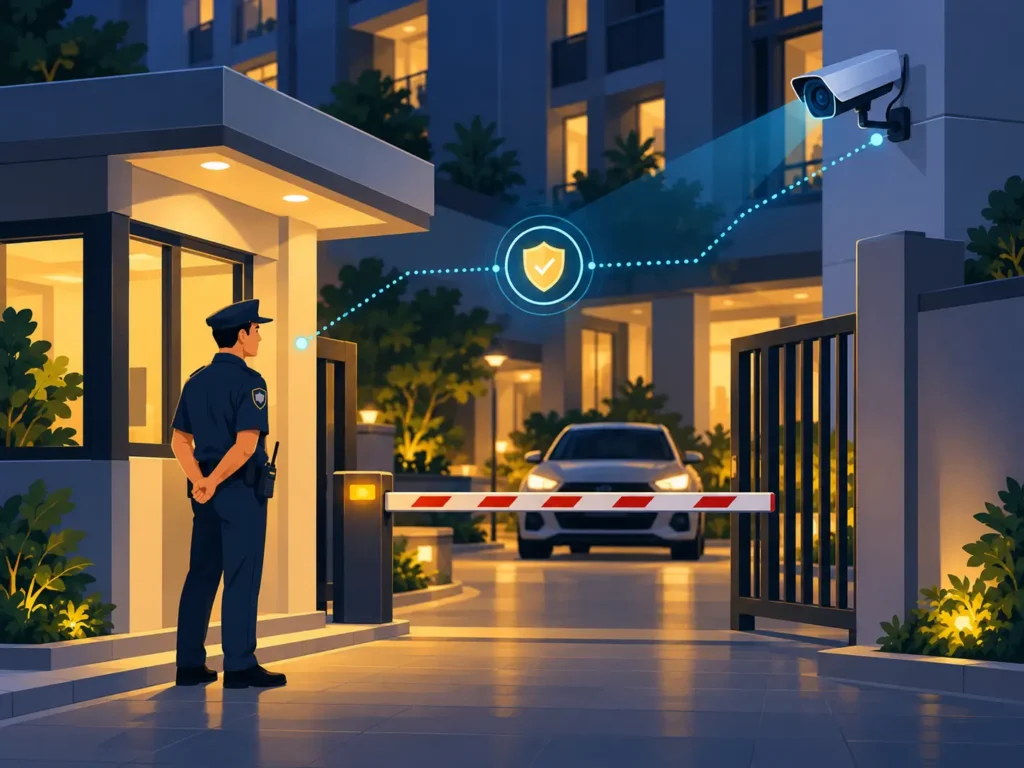
For most Indian businesses, the real answer isn’t “guards or cameras” – it’s a hybrid security model that combines both. A typical hybrid setup places one or two guards at critical access points (main gate, reception, cash counters) for physical presence and visitor handling, while a CCTV monitoring service covers the rest of the perimeter, parking areas, warehouses, and after-hours periods.
This approach lets businesses cut headcount-related costs without losing the human element where it matters most. It also builds redundancy: if a guard misses something during a shift change or blind spot, the camera network and remote operators are still watching. Many Indian security providers now package this as a single offering – a smaller manned team paired with a Security Monitoring service – precisely because it consistently outperforms either model alone on cost-per-rupee of protection.
How to Choose the Right Security Solution for Your Business
Ask these questions before deciding:
- What are you protecting? People and high-risk areas lean toward guards; assets and empty premises lean toward remote monitoring.
- What’s your budget? If 24/7 manned coverage is unaffordable, a hybrid or fully remote setup delivers comparable protection at lower cost.
- How large and complex is the site? Bigger, multi-point sites benefit more from camera coverage than from adding guards.
- What’s your risk profile? High-crime areas or sites with a history of incidents may need immediate physical response capability.
- Do you need audit-ready records? Remote monitoring provides consistent video documentation that manned guarding often can’t match.
Conclusion
There’s no single winner in the manned guarding vs remote monitoring debate – the right choice depends on what you’re protecting and what you can afford to protect it with. Security guards bring irreplaceable physical presence and judgment; Remote Monitoring brings round-the-clock, cost-efficient coverage backed by fast, verified response.
For most Indian businesses balancing budget with real protection, a hybrid security model – a lean on-site guard presence supported by a strong CCTV monitoring service – offers the most practical, scalable, and cost-effective path forward.
Frequently Asked Questions
Is remote monitoring cheaper than hiring security guards in India?
Yes, in most cases. A single 24/7 manned guarding point typically costs ₹55,000–₹90,000/month in India, while a comparable Remote Monitoring setup often costs ₹15,000–₹35,000/month, depending on camera count and service level.
Can remote monitoring fully replace security guards?
For asset protection and empty premises, often yes. But sites needing physical intervention, crowd control, or visitor management still benefit from having guards on-site, ideally as part of a hybrid model.
What is a hybrid security model?
It’s a combined approach using a smaller manned guard presence at critical points alongside a CCTV monitoring service covering the rest of the site – balancing cost, coverage, and human response.
Is CCTV monitoring reliable during power or internet outages in India?
Reputable Security Monitoring service providers use backup power and redundant connectivity (4G/5G failover) to maintain coverage during outages – this is worth confirming before signing a contract.