If you’ve ever compared quotes from security agencies, you’ve probably noticed that almost every one of them mentions being “PSARA licensed.” It sounds like standard fine print, but it’s actually one of the most important things to check before you sign a contract. A PSARA licence isn’t a formality – it’s the legal document that separates a genuine, accountable security company from an unregistered outfit operating outside the law.
In this guide, we’ll break down what a PSARA license actually means, how to run a PSARA license check online, why the licence matters when you hire a security company, and how to make sure the agency you’re considering is fully compliant.
What Is a PSARA License?
PSARA stands for the Private Security Agencies (Regulation) Act, 2005. It’s a central law enacted by the Government of India specifically to regulate how private security agencies function across the country – from guard training and background verification to uniforms, weapons (where applicable), and conduct on the job.
A PSARA licence is the official authorization issued by a state’s Controlling Authority (usually under the Home Department, through the state police) that permits a company to legally operate as a private security agency in that state. Without this licence, a business has no legal standing to supply security guards, bouncers, supervisors, or patrolling staff – no matter how professional its website or marketing looks.
Because the licence is issued state-wise, an agency operating in multiple states needs a separate PSARA licence for security operations in each one. A licence obtained in Bihar, for example, does not automatically authorize the same company to deploy guards in Uttar Pradesh or West Bengal.
Why Was PSARA Introduced?
Before 2005, the private security industry in India was largely unregulated. Anyone could set up a “security agency,” hire untrained staff, and deploy them at offices, malls, or residential societies with no background checks and no accountability. PSARA changed that by making it mandatory for agencies to:
- Verify the character and antecedents of every guard through police verification
- Provide structured training through a recognized training institute
- Maintain proper documentation, uniforms, and identity cards for staff
- Operate under a defined code of conduct and be answerable to a government authority
In short, the Act exists to protect the public – the people whose homes, offices, and assets these guards are trusted to protect.
Why the PSARA License Matters When You Hire a Security Company
When you’re evaluating who to trust with the safety of your premises, staff, or family, the licence tells you far more than a sales pitch does.
1. It Confirms the Agency Is Legally Allowed to Operate
An unlicensed agency is, by definition, operating illegally. If something goes wrong – theft, negligence, or an incident involving a guard – you have far less legal recourse when dealing with an unregistered entity.
2. It Means Guards Have Been Background-Verified
PSARA requires police verification of every security guard before deployment. This is one of the biggest reasons to insist on a licensed provider: you’re not letting a stranger with an unverified history onto your property.
3. It Signals a Baseline of Training and Professionalism
Licensed agencies must tie up with recognized training institutes and put guards through structured training before deployment. This directly affects how guards handle emergencies, conflict, and day-to-day vigilance.
4. It Protects You Contractually and Legally
Corporate clients, housing societies, banks, and government contracts increasingly make a valid PSARA licence a non-negotiable condition before awarding a security contract. Working with a licensed agency keeps your own compliance clean too.
5. It Reduces Liability Risk
If an unlicensed guard causes harm or loss, your organization could face awkward questions about due diligence. Hiring a properly licensed agency is part of demonstrating reasonable care.
Looking for a PSARA-compliant security company?
Speak with our team about your security requirements and get a solution tailored to your premises.
How to Do a PSARA License Check Online
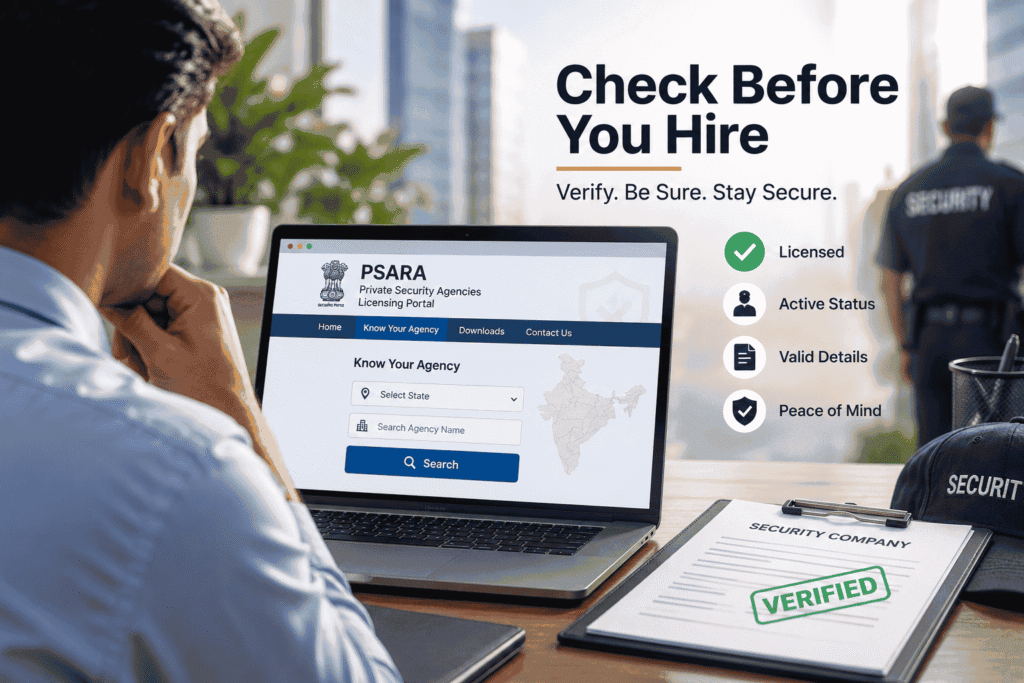
Before signing any contract, it’s worth verifying the agency’s claims rather than taking them at face value. Here’s how to approach a PSARA license check online:
- Search for the official PSARA portal. Search for “PSARA” online and open the official Private Security Agency Licensing Portal.
- Click on “Know Your Agency.” Once you are on the PSARA website, select the “Know Your Agency” option to access agency information.
- Select the relevant state. Choose the state for which you want to verify the security agency or company.
- Choose “All” from the licence status options. You will see four options: Active, Expired, Cancelled/Suspended, and All. Select “All” to search across agencies with any licence status.
- Search for the security agency or company. Look for the agency using its official company or registered business name.
- Check the “Licence Offline/Online” status. Once you find the agency in the list, check the “Licence Offline/Online” column to review its licence status and verify the agency’s details.
Here’s a video which explains how to do the above mentioned steps by yourself:
OR you can
- Ask for the licence number and a copy of the certificate. A legitimate agency will share this without hesitation.
- Check the issuing state and validity dates. Confirm the licence is valid for the state where you need the guards deployed, and that it hasn’t lapsed.
- Visit the relevant state’s Home Department or police website. Since PSARA is administered at the state level, most states host licence records or a PSARA license status lookup on their police or home department portal rather than a single national database.
- Cross-check the company name and registration details. Match the name on the certificate with the company’s registered legal name (as on its GST or incorporation documents) to rule out a borrowed or fake licence.
- Look for renewal status. PSARA licences are typically issued for a fixed term and must be renewed. An expired licence is functionally the same as having none.
If an agency is reluctant to share its licence details or provides vague answers about its PSARA licence status, treat that as a red flag.
What to Check Before You Hire a Security Company
A valid PSARA licence is the starting point, not the only thing to verify. Before you finalize a security company, also check:
- Experience and client base – how long has the agency been operating, and in what sectors (corporate, residential, banking, industrial, events)?
- Guard training and deployment process – how are guards trained, supervised, and rotated?
- Documentation – uniforms, ID cards, and badges as mandated under PSARA
- Service range – armed vs. unarmed guards, ATM security, bouncers, facility management, and manpower outsourcing, depending on your need
- Responsiveness and support – how quickly can they replace or scale staff if your requirements change?
Rajray Securex Pvt. Ltd.: A PSARA – Compliant Security Partner
This is exactly the kind of due diligence Rajray Securex Pvt. Ltd. is built to satisfy. Operating since 2006, Rajray Securex Pvt. Ltd. provides PSARA-compliant security guard services along with HR staffing, manpower outsourcing, and facility management to a wide client base across corporate offices, educational institutions, housing societies, financial institutions, and shopping malls.
Their service range covers office security, armed and unarmed guarding, ATM and bank security and bouncers for events – all backed by verified, trained personnel rather than ad hoc staffing. If you’re weighing options while trying to hire a security company you can actually verify on paper, Rajray Securex Pvt. Ltd is worth adding to your shortlist alongside a straightforward licence check.
Need a Verified Security Partner for Your Business?
Choosing the right security agency starts with proper compliance, trained personnel, and dependable service. Talk to us about your security requirements.
Final Thoughts
A PSARA licence isn’t just a certificate hanging on an office wall – it’s proof that a security agency has been vetted by the government, trains its staff, and can be held accountable if something goes wrong. Before you hire any security company, always ask for the licence number, confirm its validity for your state, and run a basic PSARA license check online rather than relying on assurances alone. It takes a few minutes and can save you from a costly, and potentially unsafe, mistake.
FAQs
1. What is the full form of PSARA?
PSARA stands for the Private Security Agencies (Regulation) Act, 2005 – the central law that regulates private security agencies in India.
2. Is a PSARA licence mandatory for all security agencies?
Yes. Any individual or business providing private security services such as guards, supervisors, or bouncers must hold a valid PSARA licence to operate legally.
3. How can I check a security agency’s PSARA licence status?
Ask the agency for its licence number and certificate, then verify it through the relevant state’s Home Department or police website, since PSARA licences are issued and tracked at the state level rather than through one central national portal.
4. Is a PSARA licence valid across all Indian states?
No. A PSARA licence is state-specific. An agency operating in more than one state must hold a separate licence for each state where it deploys guards.
5. What happens if I hire an agency without a valid PSARA licence?
You lose the legal protections and accountability that come with regulated security providers, including verified staff backgrounds and recourse in case of misconduct or negligence. It can also create compliance issues for your own organization.
6. How long is a PSARA licence valid, and does it need renewal?
PSARA licences are issued for a fixed term (commonly five years, though this can vary by state) and must be renewed before expiry to remain valid.
7. Does a PSARA licence guarantee the quality of guards?
It guarantees a baseline of police verification, training, and regulatory compliance, but it’s still worth evaluating an agency’s specific experience, training process, and client reviews before hiring.